William Chambers: Difference between revisions
No edit summary |
No edit summary |
||
| Line 11: | Line 11: | ||
== Life and the beginnings of his career == | == Life and the beginnings of his career == | ||
Chambers was the son of a Scottish family of merchants. At the age of sixteen he started to work for the Swedish East India Company. During his voyages he visited Canton in China. There he made drawings of Chinese architecture, furniture and costumes. | Chambers was the son of a Scottish family of merchants. At the age of sixteen he started to work for the Swedish East India Company. During his voyages he visited Canton in China. There he made drawings of Chinese architecture, furniture and costumes. | ||
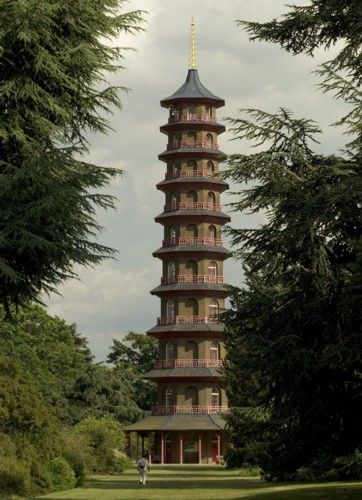
He began to study architecture. He studied it in Rome in Italy and in Paris in France. In Rome he lived together with Wilton [who or what is Wilton? . When he went to England he married Wilton's daughter. He built a lot of houses. His first important building was a villa for Lord Bessborough at Roehampton. He became famous for his grounds and buildings in Kew between 1757 and 1762 for Augusta, Princess Dowager of Wales. One of the buildings that survived is the Pagoda: | He began to study architecture. He studied it in Rome in Italy and in Paris in France. In Rome he lived together with Wilton [who or what is Wilton?]. When he went to England he married Wilton's daughter. He built a lot of houses. His first important building was a villa for Lord Bessborough at Roehampton. He became famous for his grounds and buildings in Kew between 1757 and 1762 for Augusta, Princess Dowager of Wales. One of the buildings that survived is the Pagoda: | ||
[[File:Pagoda_Kew_Gardens.jpg]] | [[File:Pagoda_Kew_Gardens.jpg]] | ||
| Line 31: | Line 31: | ||
Somerset House, town mansions for Earl Gower at Whitehall and Lord Melbourne in Piccadilly, Charlemont House, Dublin, and Duddingston House near Edinburgh, market house at Worcester | Somerset House, town mansions for Earl Gower at Whitehall and Lord Melbourne in Piccadilly, Charlemont House, Dublin, and Duddingston House near Edinburgh, market house at Worcester | ||
state coach of George III (now in the Victoria and Albert Museum) | state coach of [[George III]] (now in the Victoria and Albert Museum) | ||
Furthermore he built a lot of furniture. One among these was a combined bureau, dressing-case, jewel-cabinet and organ (made for Charles IV, king of Spain, 1793). | Furthermore he built a lot of furniture. One among these was a combined bureau, dressing-case, jewel-cabinet and organ (made for Charles IV, king of Spain, 1793). | ||
Sources: | |||
http://www.irish-architecture.com/architects_ireland/chambers.html 2010-01-18. | http://www.irish-architecture.com/architects_ireland/chambers.html 2010-01-18. | ||
Revision as of 11:26, 11 May 2010
born: 23rd February 1723 in Göteborg (Sweden) died: 8th march 1796 in London
British architect.

Life and the beginnings of his career
Chambers was the son of a Scottish family of merchants. At the age of sixteen he started to work for the Swedish East India Company. During his voyages he visited Canton in China. There he made drawings of Chinese architecture, furniture and costumes. He began to study architecture. He studied it in Rome in Italy and in Paris in France. In Rome he lived together with Wilton [who or what is Wilton?]. When he went to England he married Wilton's daughter. He built a lot of houses. His first important building was a villa for Lord Bessborough at Roehampton. He became famous for his grounds and buildings in Kew between 1757 and 1762 for Augusta, Princess Dowager of Wales. One of the buildings that survived is the Pagoda:

Published works and further career
He published a volume of designs for the buildings in Kew (1757). Chambers began to teach architectural drawing to Prince George of Wales (later George III). Treatise of Civil Architecture was published in 1759. He became an important architect and exhibited at Spring Gardens in 1761. He was one of the founding members of the Royal Academy in 1768. In 1772 he published his dissertation on Oriental Gardening. He became architect to the king and queen and surveyor-general.
Buildings:
Somerset House, town mansions for Earl Gower at Whitehall and Lord Melbourne in Piccadilly, Charlemont House, Dublin, and Duddingston House near Edinburgh, market house at Worcester state coach of George III (now in the Victoria and Albert Museum)
Furthermore he built a lot of furniture. One among these was a combined bureau, dressing-case, jewel-cabinet and organ (made for Charles IV, king of Spain, 1793).
Sources:
http://www.irish-architecture.com/architects_ireland/chambers.html 2010-01-18.
http://www.wissen.de/wde/generator/wissen/ressorts/bildung/index,page=1073800.html 2010-01-19.

http://lh4.ggpht.com/archilogy/R89_Dp0uCkI/AAAAAAAAAXs/RI9A36TLse8/s800/Pagoda_Kew_Gardens.jpg 2010-01-18.