William Kent: Difference between revisions
No edit summary |
No edit summary |
||
| (6 intermediate revisions by 2 users not shown) | |||
| Line 1: | Line 1: | ||
Born in Bridlington (Yorkshire); baptized on 1 Jan 1685; died in London, 12 April 1748. English architect, painter, landscape gardener and designer. | |||
William Kent | [[File:William Kent.jpg|thumb|170px|left|William Kent]] | ||
Kent studied painting in Rome (1709-19). There he bought paintings and sold them to the English aristocracy. In Rome he met Lord Burlington who took him back to London where Kent started to design furniture and temples on a classical theme. Kent sold these things to Burlington and his friends. Kent still painted, but he was also paid for architecture. He designed houses, their interior and their gardens. He created houses, their gardens, their interior, furniture, silverware. | |||
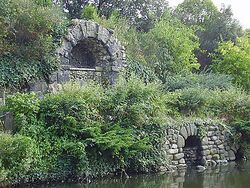
[[File:Rousham-0069.jpg|thumb|Rousham]] | |||
== Kent's style == | == Kent's style == | ||
Kent designed in both [[Palladianism|Palladian]] and [[Gothic]] style and combined both. He was a very important figure for landscaping because he paid attention to the 'naturalness' of the parks as well as to Palladian monuments in the parks. He started a movement that parks or gardens are designed, in which everything looks like nature but is combined with classical buildings or monuments. | |||
He was described by [[Horace Walpole]] as "a painter, an architect, and the father of modern gardening. In the first character he was below mediocrity; in the second, he was a restorer of the science; in the last, an original, and the inventor of an art that realizes painting and improves nature. Mahomet imagined an elysium, Kent created many." (source???) | |||
He was described by Horace Walpole | |||
"All gardening is a landscape painting" | "All gardening is a landscape painting" | ||
| Line 24: | Line 15: | ||
== | == Kent's famous works == | ||
* ''The Designs of Inigo Jones with some additional designs'' (1727) | |||
* Architectural and landscaping work still visible: [[File:ChiswickPark.jpg|thumb|Chiswick Park]] | |||
** Rousham House, Oxfordshire | |||
Architectural and landscaping work still visible: [[File:ChiswickPark.jpg]] | ** Stowe House, Buckinghamshire | ||
** Chiswick House, London | |||
Rousham House, Oxfordshire | ** Horse Guards, London | ||
Stowe House, Buckinghamshire | ** Royal Mews, London | ||
Chiswick House, London | ** Treasury buildings, London | ||
Horse Guards, London | ** Number 10, [[Downing Street]], London | ||
Royal Mews, London | |||
Treasury buildings, London | |||
== Sources == | |||
* Colvin, Howard, (1995) ''A Biographical Dictionary of British Architects, 1600-1840''. 3rd ed., 1995, s.v. "Kent, William". | |||
* Hunt, John Dixon, (1986; 1996) ''Garden and Grove: The Italian Renaissance Garden in the English Imagination, 1600-1750'', London: Dent. | |||
* Hunt, John Dixon, (1987) ''William Kent, Landscape garden designer: An Assessment and Catalogue of his designs''. London: Zwemmer. | |||
* Mowl, Timothy, (2006) ''William Kent: Architect, Designer, Opportunist''. London: Jonathan Cape. | |||
* Rogers, E., (2001) ''Landscape design a cultural and architectural history''. New York: Harry N. Abrams. | |||
* Ross, David, (2000) William Kent. Britain Express, 1-2. <http://www.britainexpress.com/History/bio/kent.htm>. 12-19-2009. | |||
== | === Images === | ||
* http://www.answers.com/topic/william-kent. 12-19-2009 | |||
* http://images.google.de/imgres?imgurl=http://www.panoramio.com/photos/original/2244369.jpg&imgrefurl=http://www.panoramio.com/photo/2244369&usg=__jvBsGUNe7uUtg7PyLy8fkKvIfpU=&h=1536&w=2048&sz=677&hl=de&start=94&um=1&tbnid=yscM3hgubxawMM:&tbnh=113&tbnw=150&prev=/images%3Fq%3Dwilliam%2Bkent%26ndsp%3D18%26hl%3Dde%26sa%3DN%26start%3D90%26um%3D1. 12-19-2009 | |||
__NOTOC__ | |||
Latest revision as of 14:24, 22 October 2018
Born in Bridlington (Yorkshire); baptized on 1 Jan 1685; died in London, 12 April 1748. English architect, painter, landscape gardener and designer.

Kent studied painting in Rome (1709-19). There he bought paintings and sold them to the English aristocracy. In Rome he met Lord Burlington who took him back to London where Kent started to design furniture and temples on a classical theme. Kent sold these things to Burlington and his friends. Kent still painted, but he was also paid for architecture. He designed houses, their interior and their gardens. He created houses, their gardens, their interior, furniture, silverware.

Kent's style
Kent designed in both Palladian and Gothic style and combined both. He was a very important figure for landscaping because he paid attention to the 'naturalness' of the parks as well as to Palladian monuments in the parks. He started a movement that parks or gardens are designed, in which everything looks like nature but is combined with classical buildings or monuments.
He was described by Horace Walpole as "a painter, an architect, and the father of modern gardening. In the first character he was below mediocrity; in the second, he was a restorer of the science; in the last, an original, and the inventor of an art that realizes painting and improves nature. Mahomet imagined an elysium, Kent created many." (source???)
"All gardening is a landscape painting" William Kent
Kent's famous works
- The Designs of Inigo Jones with some additional designs (1727)
- Architectural and landscaping work still visible:
Chiswick Park - Rousham House, Oxfordshire
- Stowe House, Buckinghamshire
- Chiswick House, London
- Horse Guards, London
- Royal Mews, London
- Treasury buildings, London
- Number 10, Downing Street, London

Sources
- Colvin, Howard, (1995) A Biographical Dictionary of British Architects, 1600-1840. 3rd ed., 1995, s.v. "Kent, William".
- Hunt, John Dixon, (1986; 1996) Garden and Grove: The Italian Renaissance Garden in the English Imagination, 1600-1750, London: Dent.
- Hunt, John Dixon, (1987) William Kent, Landscape garden designer: An Assessment and Catalogue of his designs. London: Zwemmer.
- Mowl, Timothy, (2006) William Kent: Architect, Designer, Opportunist. London: Jonathan Cape.
- Rogers, E., (2001) Landscape design a cultural and architectural history. New York: Harry N. Abrams.
- Ross, David, (2000) William Kent. Britain Express, 1-2. <http://www.britainexpress.com/History/bio/kent.htm>. 12-19-2009.
Images
- http://www.answers.com/topic/william-kent. 12-19-2009
- http://images.google.de/imgres?imgurl=http://www.panoramio.com/photos/original/2244369.jpg&imgrefurl=http://www.panoramio.com/photo/2244369&usg=__jvBsGUNe7uUtg7PyLy8fkKvIfpU=&h=1536&w=2048&sz=677&hl=de&start=94&um=1&tbnid=yscM3hgubxawMM:&tbnh=113&tbnw=150&prev=/images%3Fq%3Dwilliam%2Bkent%26ndsp%3D18%26hl%3Dde%26sa%3DN%26start%3D90%26um%3D1. 12-19-2009
